
Murray City Directory Collections
The surviving city directories for Murray sit in more than one place. The strongest named digital item is the University of Utah Marriott Digital Library’s Utah City Directories Collection, which includes a 1910 Polk Salt Lake volume that names Murray in its title. Local holdings are less neatly quantified. Murray Library staff can confirm catalog and local-history holdings, while the Murray Museum keeps person-centered files and old Murray Eagle material. Utah Historical Society finding aid MSS B 814 describes Murray City Records from 1936 through 1976.
| Collection | Years or clue | Where held | Access |
|---|---|---|---|
| Polk Salt Lake directory | 1910 item includes Murray | Marriott Digital Library | Digital collection |
| Murray City Records | 1936-1976 | Utah Historical Society, MSS B 814 | Finding aid and request path |
| Local history and newspapers | Run needs staff confirmation | Murray Library | Catalog, online tools, in person |
| Family files and yearbooks | More than 300 family files | Murray Museum | Research inquiry and onsite use |
There is no verified claim here that every year survived or that every local volume is online. Treat the collection itself as the first research question. The digital 1910 item is a useful start, but a gap in the screen may reflect a missing year, a different publisher, an access limit, or a name that was indexed under a variant.
Inside the 1910 Polk Murray Volume
The 1910 Polk Salt Lake directory matters because it places Murray inside a regional directory rather than assuming the city had a separate book. Search by surname first, then read the address and nearby entries. A city directory page can contain a person’s name, spouse notation, street address, and an occupation or business line. It can also use abbreviations or marks that make a quick transcription misleading.
The Marriott collection is a browser-based source. Save the volume title and page number with each note. If the collection server is difficult to search, use the title and Murray clue to ask a librarian for help. Pair a directory address with a deed, tax roll, census schedule, cemetery record, or newspaper before treating it as a family match.
The image below shows the local library route that can help with a volume whose online scan or index is incomplete.
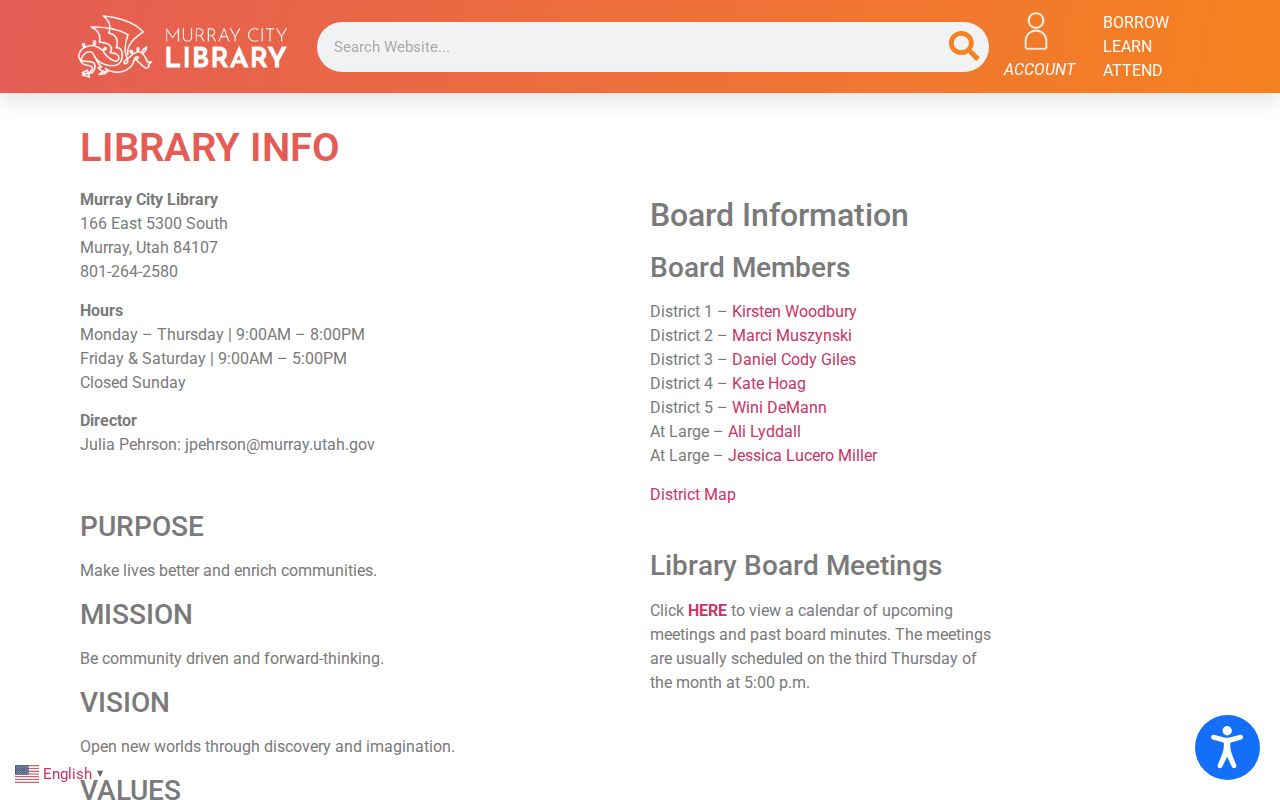
Library staff can confirm what is held, but the public library page does not state a full quantified directory run.
How a Murray Directory Entry Reads
Read an entry from left to right, but do not skip the front matter. The title page establishes place and year. The abbreviation key explains short forms. The alphabetical section identifies names. The street or criss-cross section turns an address back into a household clue. One volume may use a householder mark or show a spouse in parentheses; another may handle the same detail in a different way.
| Entry part | What to record |
|---|---|
| Name | Exact spelling, initials, spouse or family notation |
| Address | Number, street, direction, and any apartment or business note |
| Work line | Occupation or business wording as printed |
| Owner mark | Any symbol or abbreviation used by that volume |
| Page and year | Volume title, edition, page, and scan link |
- Criss-cross directory
- A reverse directory arranged by street address instead of surname.
- Householder index
- A name list that points to a household or address entry.
- Abbreviation key
- The volume’s guide to short forms, marks, and symbols.
A directory entry is evidence for a year. It is not a current status check, a deed, or a certified vital record.
Trace a Murray Household Across Years
A good city directory workflow keeps each year separate. Start with the earliest likely volume, copy the name as printed, and record every address change. Then use the reverse section to see who shared the block. Compare the same household with census years, newspapers, school yearbooks, church registers, and cemetery data. A name that vanishes may signal a move, death, a missed edition, a spelling change, or a publication gap.
- Choose a year and confirm the volume’s city or county scope.
- Find the surname and record page, address, family marks, and abbreviations.
- Repeat for the next available year and mark moves or spelling changes.
- Use the street section to identify nearby names and businesses.
- Pair the address with a census decade, deed, obituary, or museum file.
The Murray by-address guide handles current parcel records. Keep the historical directory task here so modern owner data does not get mistaken for an old occupant record.
Murray Directory Years and Census Decades
Census schedules and city directories answer related but different questions. A census records a household at a federal enumeration date. A directory is a compiled snapshot that may have been gathered earlier and may omit people who were not listed. The 72-year public-access rule for federal census records creates a useful historical check, but it does not fill a year that no directory covered.
For Murray, compare the 1910 Polk item with the 1910 census, then look for the same street or surname in later decades. Note whether the directory shows a spouse or boarder mark, and whether the census household has a different spelling. A match is stronger when name, address, family connection, and time all agree. A mismatch deserves another source, not a guess.
Murray Museum Files Add Human Context
The Murray Museum holds more than 300 cataloged family biographies, high-school yearbooks, personal and organization scrapbooks, newspaper clippings, historic-home material, photographs, old Murray Eagle issues through the city’s digital-newspaper link, and more than 56 oral histories. These materials can connect a directory name to a school, congregation, club, service story, or long-time family. Give staff a surname, approximate date, street, organization, or family link.
The museum is at the historic Cahoon Mansion, 4872 South Poplar Street. Regular hours listed by the city are Monday and Wednesday 9 a.m. to 5 p.m., Tuesday, Thursday, and Friday 9 a.m. to 1 p.m. Research inquiries go to Rowan Coates at rcoates@murray.utah.gov or (801) 264-2589. Staff may check whether a file exists, but the collection is not a promise of a complete research project.
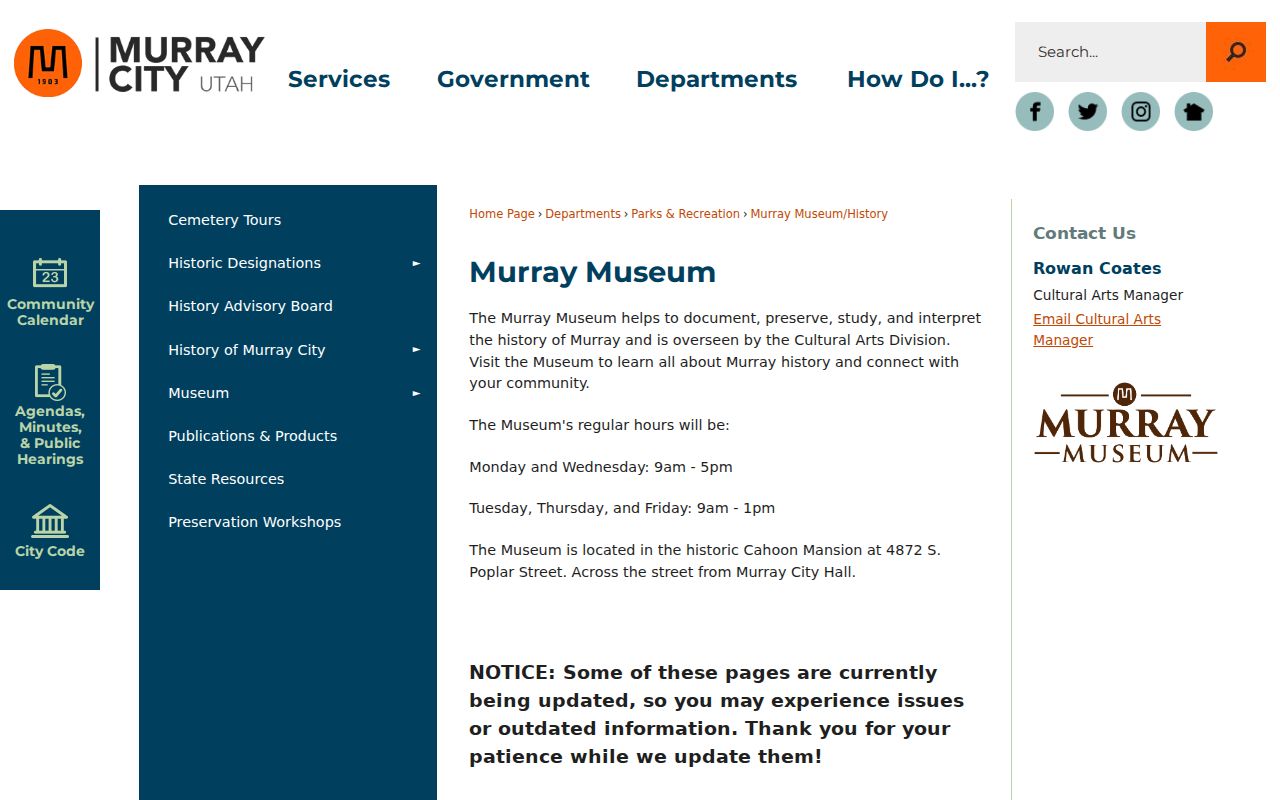
The museum’s collection is especially useful when a printed directory gives a name but little family detail.
Newspapers Close Murray Directory Gaps
The Murray Eagle and other Utah newspaper resources can supply an address, business, club, school, marriage, funeral, or legal notice that a directory leaves out. The Murray Museum holds clippings and scrapbooks, and its collections page points to older Murray Eagle issues online. Obituaries can establish a death date, relatives, congregation, or former address. Treat family contact details with care and use the information as a trail to the custodian or archive.
Before 1898, Utah had no general government requirement to record deaths. Murray’s earlier residents may therefore be found in newspapers, cemetery entries, church registers, probate, land, and tax rolls. Utah Cemetery and Burials supports name, death-year, cemetery, county, and city searches. A cemetery result can add burial date, grave location, and relatives, but it does not replace a directory page or death certificate.
Murray Church Records Explain Directory Names
Murray’s smelter and railroad era drew Greek, Armenian, Yugoslavian, Italian, and Japanese workers, along with early Latter-day Saint and other local communities. Methodist, Baptist, Lutheran, Catholic, and LDS registers can help explain why the same family appears with several spellings. Established catalog material identifies St. Jude Maronite Catholic Church registers in Murray from 1976 through 1994 and Murray or Grant Ward member records around 1900 through 1941, with access to be confirmed.
Use alternate spellings, initials, and the street address when a directory search fails. Church and cemetery evidence works best beside a newspaper, deed, census, or museum file. A community link can strengthen family history without turning a single name into a claim about a present-day person.
Murray’s Record Geography Changed
Murray grew from South Cottonwood settlement into an agricultural, railroad, and smelter city. The post office adopted the Murray name in 1883. A close 1902 incorporation vote led to county recognition on November 25, 1902, followed by state recognition on January 3, 1903. State Street, rail and trolley connections, Jordan River, and Big Cottonwood Creek shaped the address landscape that old city directories captured.
That history matters when a directory address seems absent from a current map. The tax-roll arrangement used ward and surname through 1892, then shifted toward legal description by plat and block in 1893. Check a plat, ward, legal description, or county Archives source before assuming the directory is wrong. The separate page for past residents follows one address backward through those sources.
Where to Continue a Murray Directory Search
The Murray Library is at 166 East 5300 South, with public computers, catalog access, and online resources. Hours listed are Monday through Thursday 9 a.m. to 8 p.m., Friday and Saturday 9 a.m. to 5 p.m., closed Sunday. Salt Lake County residents can obtain an adult resident card with government photo ID and proof of address; out-of-state users may obtain a guest pass for internet access with photo ID.
For government records from 1936 through 1976, consult the Utah Historical Society’s Murray City Records finding aid. For property-era context, use Salt Lake County Archives, which holds tax cards, permits, deeds, plats, maps, and land-title material. When a name appears in a directory but not a modern roll, ask the relevant custodian for an existing record under Utah GRAMA rather than asking an office to create a new list.